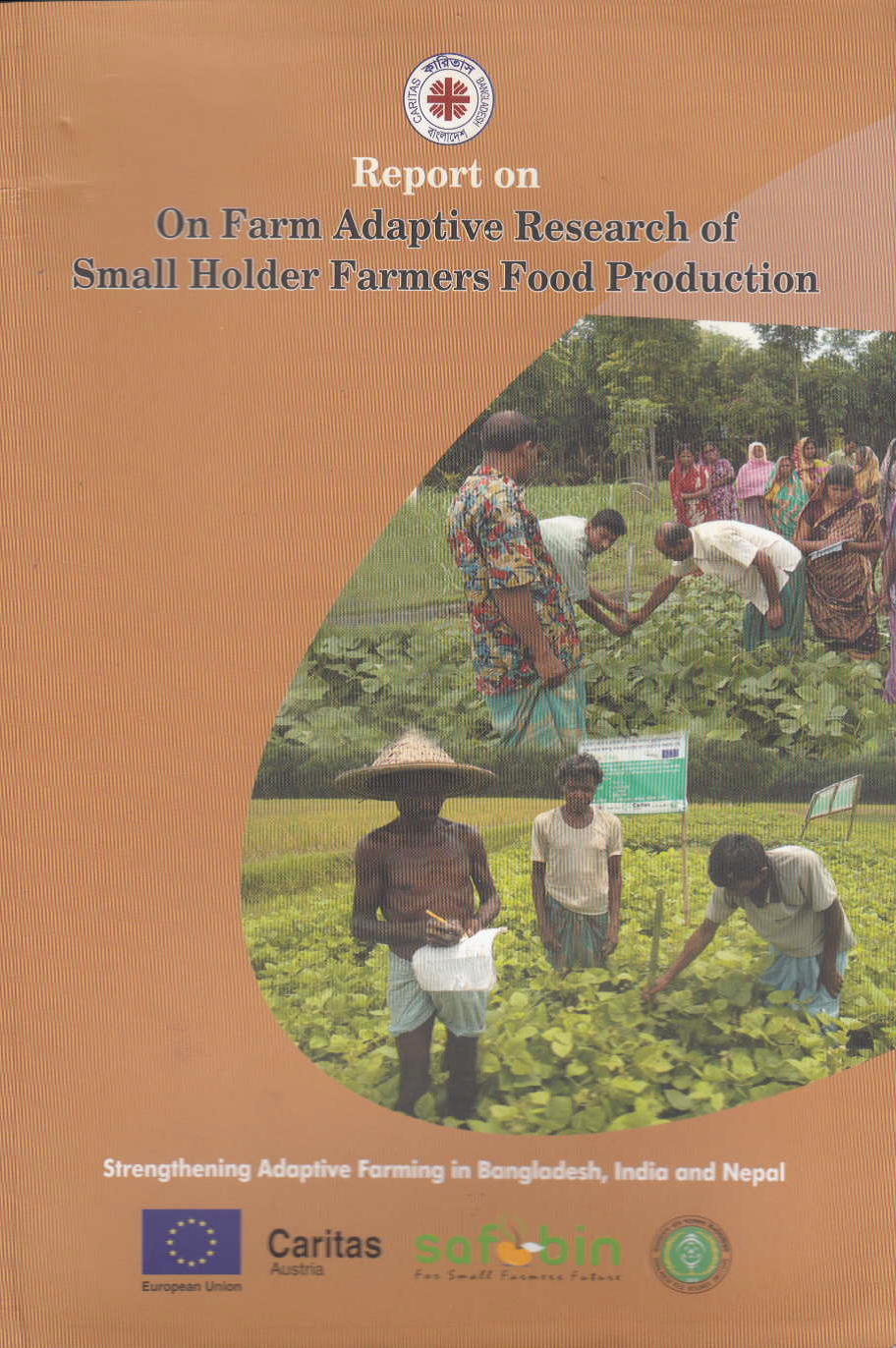
Agriculture in rural part of Nepal is traditional, which depends mainly on Indigenous Traditional Knowledge (ITK) that has been acquired by people from their ancestors. ITKs are usually followed by the people in day to day life, may it be in agriculture, animal husbandry, seed/grain conservation or storage, medicines, food, etc. It has been a part of their culture itself.Small-holder farmers possess small land holdings. The produce is used mainly for household consumption and planting for next year. Therefore, the role of indigenous storage structures is important, as most of the farm produce are stored at HH level.Due to the heavy rainfall during rainy season it becomes difficult for safe storage of the grain for a season or two. In rural parts of Nawalparasi most of the produced paddy are stored at traditional homemade structures that involves bamboo baskets(Bhakari) to gunny bags and modern bins. One of the praiseworthy actions recognized by the farmers and farming community over time is the development of innovative arrangements where the grains/seeds can be successfully stored devoid of the storage insect pest and rodents. One of the household of SHFC member (Mrs. Khimauti Soti) of Madyabindu -14, Rakachuli Lower of Nawalparasi, Nepal has been continuing the knitting of bamboo baskets as a part of Indigenous Traditional knowledge till now.There are very less other Person in her village including her husband (Mr. Thaman Sing Soti) who have the skills of knitting the bamboo baskets (Bhakari). It requires 3-4 Bamboo culms to prepare a medium sized bamboo basket. Her household has already earned Rs 8000 from selling of 4 similar bamboo baskets in the village in this time. As per her saying, they can store the paddy as well as grains successfully inside the basket for 3-4 years devoid of the storage pest, insects and rodents.The storage needs of small scale farmers have always been fulfilled by indigenous structures produced and designed by farmers with easily and economically available materials. Though the mechanized and modern mode of agriculture have been occupying gradually in the district, the ITKs are still playing an essential role in promoting the sustainable agriculture in the resource poor parts of the country.
Author: Ashwin George
-

Duck Farming: Rozina Leads the way
Food and nutritional security is one of the major challenges that the smallholders and other marginalised communities face in the era of global health and environmental problems such as the pandemics and climate change, including biodiversity loss. Smallholder farmers are now adopting practices that reduce the impact of climate change impacts and more importantly, the impact of pandemic as the world is now witnessing. With the promotion of farm diversity using the Integrated Farming System approach, farmers like Rozina Begum in Bangladesh are emerging resilient and are ensuring their and their families’ food and nutritional security are being met. Rozina Begum and her husband, Md. Digonto are a smallholder couple. They live in Kornoher village in Paba, Rajshahi district. With just 0.13 ha of cultivable land, they were finding it difficult to meet the needs of the family that has two children.Rozina Begum, who joined the SAFBIN facilitated Smallholder Farmers’ Collective in her village, was eager to do something to contribute to the family income. She decided to diversify her small farm by adding duck farming and vegetable cultivation in her homestead. The programme supported her with 65 ducklings to help her start her duck farm. Now all the ducks have started laying eggs. She collects 25-30 eggs daily from her farm. While eggs and meat are now being consumed regularly in her family, they are also able to sell them locally as well. She has sold around 400 eggs till now and earned 4,000 BDT. Now they are selling ducks to the local community and have already sold 55 ducks and earned 13,750 BDT while adding 45 new born ducklings to her own farm. With the nutrition garden, Rozina cultivated different types of vegetables year-round. She has sold 751 Kg vegetables and earned 15,030 BDT.From the time Rozina got involved with the programme, she has been able to work through to see palpable changes in her life. She now leads the way to demonstrate to her fellow farmers how farm diversification helps to emerge resilient and become self-reliant.
-
Smallholder Farmers: At the Heart of Climate Action
Climate change and the multiplying effects of the COVID-19 pandemic have come together to further push smallholder farmers into hunger and poverty. The rise in global average temperatures, as well as increased unpredictability of rainfall, are having profound impacts on agriculture and inevitably affecting smallholder production systems leading to environmental degradation and food insecurity. Moreover, smallholder farmers are increasingly losing out on market opportunities while the supply chains are getting disrupted. The WFP estimates 135 million people face crisis levels of hunger, and another 130 million are on the edge of starvation as a result of COVID-19.Despite their importance in global food production, smallholder farmers comprise the majority of the world’s undernourished population and most of those living in absolute poverty (UN Millennium Project 2005a; IFAD 2011a). Smallholder farmers are characterized by marginalization, in terms of accessibility, resources, information, technology, capital and assets“Though we were cultivating vegetables for decades, it was limited to 3-4 species and varieties. This was due to a lack of proper knowledge and awareness among women like us.” says Ms. Nanibai, member of Awar Mata Kishan Samoh, India.Food security continues to be a matter of grave concern for countries like India. Despite being the second-largest producer of food, India is home to the world’s second-largest undernourished population (195.9 million) Food secure households with adequate nutritional status would mean improving what people eat, in terms of quality, quantity, and diversity. This in turn requires efforts related to availability as well as economic access to the food supply.Smallholder farming have the potential to impact human nutrition by providing a variety of food in sufficient quantities to enable all household members to eat a nutritionally adequate diet. With their immense collective experience and intimate knowledge of local conditions, smallholders hold many of the practical solutions that can help place agriculture on a more sustainable and equitable footing.Smallholder Adaptive Farming and Biodiversity (SAFBIN) programme worked with smallholder farmers to have greater availability of a variety of nutritious foods at community and household levels through introduction of new crops and animals, the promotion of traditional food crops, and home based nutrition gardens. A total of 756 small farm families in the programme areas in India have diversified with 13-14 varieties of local fruits and vegetables and are consuming locally produced culturally preferred balanced diet by adding necessary vitamins and minerals in their daily food intake.The farmers have not looked back since then. They have been busy in diversifying their farms and nutrition garden tending to the plants, vegetables and trees and preparing organic manures and insect repellents to promote their growth and protect them from pests.Creating awareness on the importance of consuming vegetables to address micronutrient deficiencies, sanitation, personal hygiene and attention to the health of pregnant and lactating mothers with children in particular has been central. Coordination with local stakeholders like Anganwadi, nutrition rehabilitation centers district health department, school committee was an integral component of SAFBIN nutrition awareness drive.“The community-led approach initiated to combat malnutrition by the SAFBIN program is accepted by many farmers in our village. It is really helpful for us to know about the local food as well as their health. I have my own nutrition garden with 13 varieties of local fruits and vegetables in my backyard now for around the year.” Said Rampyari, a member of Chandni Kishan Samoh of Khusipura village.Promotion of climate resilient and nutritionally relevant local vegetables and fruits have resulted in greater resilience of the farmers. Seed exchanges among the farmers contributed to improved agrobiodiversity and maintenance of a diverse pool of indigenous seeds in the districts.The conceptualization of a nutrition garden aims to address the daily food requirement for the family. Nutrition gardens are nothing but home gardens of natural and bio-fortified fruits and vegetables of high nutritive value where the species selection is inclusive of the three vegetable groups viz., green leafy vegetables, roots and tubers and other vegetables with specific attention to addressing micro-nutrient (vitamins and minerals) deficiencies, particularly iron and vitamin A. Usually, in rural areas where the diets particularly of pregnant and lactating women, pre-school children are generally found deficient in micro-nutrients. However, these nutrition gardens ensure staple-based diets with a significant portion of proteins, vitamins, and minerals, leading to an enriched and balanced diet.
-
Mushroom Enterprise-A collective effort towards Climate change and farm diversity
Rainfall and temperature variability are becoming more profound in South Asia. Smallholders relying on rainfed agriculture are particularly affected and have to adapt their farming systems accordingly.In order to adapt, SAFBIN smallholder are adopting more sustainable adaptation approaches that protect them from the negative impacts while being cost-effective and widely applicable.In Nepal, mushrooms are popular in local diets, commonly foraged in the forest during the rainy season. Cultivated mushrooms are now also being preferred among the households because of being affordable and nutritious source of fiber, minerals and vitamins. They’re increasingly being adopted by farmers due to their quick return on investment and ability to grow in small spaces.Farmers in Surkhet district of Nepal, used to do mushroom cultivation on a very small scale a few years back. They have never thought of this as a good alternative for food and nutrition security as well as an income generating source.Though the farmers had some knowledge about household mushroom cultivation they have never incorporated this as an important component in their farming system. This is because of less technical knowledge and unavailability of spore (seed). They used to consume only wild edible mushrooms in the jungles available during the monsoon season. In order to fulfill this gap, Caritas SAFBIN provided farmers 2 days of practical training in mushroom production and also provided the spores.After receiving the training, 208 farmers from different locations started mushroom cultivation in their houses individually. After the first attempt, they were very excited to see the production. In an average each farmer produced around 12 kg of mushroom which they consumed in their household, shared with the neighbors and sold the surplus production in the local markets nearby.After one-two production cycles, they scaled up the production and started to sell the production collectively in the bigger markets and district headquarter. Later they realized that per unit production cost could be reduced by collectivizing the equipment and labor. Thus they decided to combine their resources and go for collective mushroom production on a commercial scale. Currently, three smallholder farmers groups are doing collective mushroom production. SAFBIN has supported seed money of Rs 25,000 (200 Euro) for each of these 3 groups to promote small and medium enterprise on commercial mushroom farming.At present, each group makes an income of Rs. 30,000-40,000 (200 – 350 Euro) per season from the investment of NRS 8000- 10000 (60-80 Euro). It is expected that the group will take forward this in a bigger scale as an enterprise even after SAFBIN project phases out.Mushroom practice can easily be adopted by small-scale farmers to help them diversify incomes, especially when climate variabilities may challenge conventional farming, and reduce their vulnerability to adverse weather.
-
Safia’s Homestead: A source of additional Income
Safia bibi, a smallholder farmer from village 36/SB of Sargodha district in Pakistan has come a long way. With her son working as daily wage laborer, the only other income comes from selling milk in her village. Motivated by SAFBIN awareness and capacity building sessions on various topics that included farm diversification, green manuring and pulses integration, balanced diet & nutrition, she decided to start her own organic vegetable farming. Safia obtained one kanal piece of land (505 square meters or 605 square yards) on lease in 2020 for vegetable cultivation. She started producing different summer and winter vegetables and was able to sell most of the vegetables in her village. In the recent summer season, she harvested beans, pumpkin and lady finger from her homestead garden. On an average she earns PKR 6000 to 7000 per month from selling these vegetables. Apart from this, she continues to sell milk from two buffaloes, one of them is milking and she is able to collect 5-6 liters of milk daily. She keeps 2 liters milk for domestic consumption and sells rest of the 4 liters in the village and earns PKR 8500 per month from milk. Safia has now also introduced medicinal plants in her homestead.Safia along with 119 other smallholder farmers of her village have been attending various capacity building sessions participated on improving soil fertility, efficient use of natural resources, pulses integration for nitrogen fixation and protein intake; and consuming nutritious foods for balanced diet.Farmers like Safia are observing positive changes in their nutrition, income and marketing. Safia is now aware that it is important to maintain good health by consuming fresh and safe vegetables and dairy products. Introducing Vegetable component in her farm has not only become an additional source of income, she does not need to travel to local market which keeps her safer during these difficult pandemic times. Selling her farm products in the village, she does not need to depend on middleman and is able to save any transportation cost.
-
Small irrigation schemes brings back big hopes for smallholder farmers
“Despite of having big opportunity to cultivate additional crops in winter, we had to leave most of our land fallow because of no irrigation facilities in this area.” said Ms. Geeta Tharu, when SAFBIN visited her field in Beluwa of Bardia distrct. This was not only her and her community’s story but there were more similar stories from the smallholder farmers from Surkhet and Nawalparasi districts. Other farmers like Ms. Tara from Surkhet and Mr. Tek Bahadur Thal from Nawalarasi had the same to say. They also had to keep their land fallow for more than 6 months in a year because of the same reason.Based on the demand of the farmers to have better access to water for irrigation, SAFBIN team initiated a dialogue with the local government and farmers to have collaborative irrigation schemes in the different project locations. The local government and the farmer’s communities were very excited with the idea. In less than five months of period, SAFBIN, in coordination and collaboration with the rural/ municipalities and local smallholder farmers, was able to restore and rebuild four irrigation canals from different districts. This has not only benefited the smallholder farmers affiliated with SAFBIN program but also has brought hopes for many other farmers in the locations. More than 380 farmers now have a plan to cultivate at least two additional crops in almost 150 hectare of land this winter which would have otherwise remained fallow. Mr. Bishnu Prasad Acharya, Ward Chairperson of Rajahar, Nawaplarasi, told that the municipality is very happy to work together with Caritas to bring back the smiles of the smallholder farmers.SAFBIN will continue to work in coordination and collaboration with the local government, farmers and other local stakeholders to improve the livelihood and increase income of the smallholder farmers.
-
Cluster Level Facilitator (CLF): Adding Value to Smallholder led Value Chain
Mandla district of Madhya Pradesh is famous for its rich natural resources and yet it is one of the most backward areas in the State. Low food productivity, high dependence on wages, increased sale of fuelwood and high incidences of migration are some of the critical issues in the region.Since Cereals like paddy and millet are the lifeline of smallholders of the region, the dependence on the monsoon rain for agriculture production has always been risky and increase their risk manifolds when it tied with climate change and weather uncertainty. In addition to this, the unfolding COVID-19 crisis has also exposed and intensified the risks in the entire food system.“Majority of the smallholders like me depends mostly on the monsoon rain but this year the risk was, even more, higher due to covid-19 pandemic, putting many new challenges before us to ensure food security,” says Subhadra Bai Sahu, Cluster Level Facilitators (CLF) of Ghonta cluster, Mandla.The CLFs was promoted by the SAFBIN at the cluster level to ease the process of collectivisation, aggregation, packing and marketing for potential small farm produces. They are the first level facilitators to plan, guide and manage the backward and forward linkages between farmers and buyers.The SAFBIN form of smallholder led value chain works under three major levels including CLF, FPO and Marketing. The role of cluster-level facilitator (CLF) being one of the most crucial positions to help the smallholder in linking potential small farm produces to the larger markets and traders at a competitive price.Clusters were developed to take the maximum leverage for the farmers. Within a cluster co-operation, smallholders can access to specific inputs and information related to their farm. It is a recognised way to enhance productivity through innovative models and interventions by providing basic technical support.Clusters can allow small farm collectives to combine advantages with various benefits. Hence, SAFBIN demarcated the entire program areas into seven clusters and placed equal numbers of cluster-level facilitators to ensure quality services to enhance small farm productions and linking potential commodities to the larger market.Recently, 42 smallholder farmers collectively aggregated 6MT of indigenous variety millet (Kodo: 3MT and Kutki: 3MT) and sold at the trader’s market in coordination with cluster-level facilitators @ Rs. 1,800/- and @Rs. 2,900/- per quintals respectively and a sum of Rs. 1,41,000/- been received collectively.“Often, we had to depend on others to take ours produces to local market or sale to the person who comes to buy at the village with any rate suited to the situation. But we could see the benefit received by collecting our surplus grains and selling on a competitive rate after negotiation through the CLF,” shares Mamta Bai, one of the SHFC members of Jaitpuri village.Smallholder Adaptive Farming and Biodiversity Network (SAFBIN) is committed to strengthening smallholders’ capacity through eco-friendly adaptive best practices to enhance farm production and productivity, ensuring access to and usage of quality farm inputs and services, facilitating access to fair, remunerative and competitive markets including linking smallholders to better marketing opportunities.
-
Smallholders access to Land Rights: A step towards SDG 2
Access to land, tenure security and sustainable use of land are essential to achieve food and nutrition security and Zero Hunger (Sustainable Development Goal 2). We cannot achieve food and nutrition security or even for that matter poverty reduction unless the issues related to access to land, tenure security and sustainable use of land are addressed. South Asian Countries like India are still tackling the issue of inadequate access to land, especially by smallholder farmers who are the main producers of food in the region. To double farm income and production, the smallholders need to have secured access to land.The information gap on land and land tenure security is huge in the South Asian region. There are still age-old practices of verbal agreement being followed by smallholder farmers because they lack information on land rights. There have been increasing incidences of exploitation and loss of compensation due to lack of documentation, because of which many are not able to access government schemes and entitlements that require formal documents. Moreover, South Asia also sees high number of land grabs, displacements, and resettlements of people due to issues related to land ownership and the lack of it, being aggravated by climate change and disasters. Though there are land policies in place that can ensure protection and assure land tenure security, there is an urgent requirement of getting these policies down to the ground through awareness generation and capacity building.SAFBIN programme with its overall goal of contributing to SDG2- ending zero hunger is working with 4050 smallholder farmer households in four South Asian countries of Bangladesh, India, Nepal and Pakistan. Through Integrated farming system, climate adaptive practices, multistakeholder partnerships, value chain activities and access to rights and entitlements, SAFBIN has been able to successfully demonstrate that smallholder farmers have high potential to double farm production and income. With better access to land and land tenure security, smallholder farmers can promote sustainable production and income, and ecological conservation. Therefore, it becomes crucial for the farmers to have access to land and tenure security in which protection, documentation, registration, formalisation is granted. The programme has been building capacities of her smallholder farmers to help them access rights and entitlements. Through various trainings, interface meetings and workshops with government officials and experts, farmers are now becoming aware of land related rights and entitlements.In meetings and workshops facilitated by SAFBIN programme in India, farmers got the opportunities to have interface meetings and interact directly with office bearers, landlords and land experts. In one such workshops, legal experts were brought in to build farmers’ awareness around land rights. 85 farmers registered online to apply for land ‘patta’ or land deed. One farmer, Mr. Prakash from Sagar district of Madhya Pradesh, went on to get a legal affidavit made for his leased land. This crucial step has secured Mr. Prakash’s crops that will protect him of any losses due to crop damage and allow him to access compensation that otherwise would have gone to the land owner. This is a small but critical step for smallholder farmers like him to not only protect their rights but also help them in their capacities to be more resilient to climate change impact and calamities.There is critical relationship between food and nutritional security and land tenure security, and to address the former, it is important to address the latter as well. Mr. Prakash has now become the first person from his block who did land leasing in the formal way. He has now become an inspiration to many, and more farmers are coming forward to ensure that their rights are being protected.
-
Duck Farming: Rozina Leads the way
Food and nutritional security is one of the major challenges that the smallholders and other marginalised communities face in the era of global health and environmental problems such as the pandemics and climate change, including biodiversity loss. Smallholder farmers are now adopting practices that reduce the impact of climate change impacts and more importantly, the impact of pandemic as the world is now witnessing. With the promotion of farm diversity using the Integrated Farming System approach, farmers like Rozina Begum in Bangladesh are emerging resilient and are ensuring their and their families’ food and nutritional security are being met. Rozina Begum and her husband, Md. Digonto are a smallholder couple. They live in Kornoher village in Paba, Rajshahi district. With just 0.13 ha of cultivable land, they were finding it difficult to meet the needs of the family that has two children.Rozina Begum, who joined the SAFBIN facilitated Smallholder Farmers’ Collective in her village, was eager to do something to contribute to the family income. She decided to diversify her small farm by adding duck farming and vegetable cultivation in her homestead. The programme supported her with 65 ducklings to help her start her duck farm. Now all the ducks have started laying eggs. She collects 25-30 eggs daily from her farm. While eggs and meat are now being consumed regularly in her family, they are also able to sell them locally as well. She has sold around 400 eggs till now and earned 4,000 BDT. Now they are selling ducks to the local community and have already sold 55 ducks and earned 13,750 BDT while adding 45 new born ducklings to her own farm. With the nutrition garden, Rozina cultivated different types of vegetables year-round. She has sold 751 Kg vegetables and earned 15,030 BDT.From the time Rozina got involved with the programme, she has been able to work through to see palpable changes in her life. She now leads the way to demonstrate to her fellow farmers how farm diversification helps to emerge resilient and become self-reliant.
-
Smallholders in Bangladesh transform their drought-prone farms
Four years ago, when SAFBIN started working with 405 smallholder families in Tanore of Rajshahi, Bangladesh, increasing agricultural production in this drought-prone Barind region was a challenging task. But farmers like Ms. Akhtara Begum (42) accepted that challenge. She is a progressive farmer from Chimna village. Her husband Md. Ruhul Amin (47) inherits a piece of ancestral homeland and a 33 decimal farmland. He leases another 17 decimal farmland on his own. Besides, he used to run different seasonal small businesses for a living. Paddy was the only crop that Akhtara’s family used to grow on their farmland. But their production was not sufficient to supply rice for more than five-six months of the year. Like the other food items, rice had to be bought from the market for about half of the year.Akhtara’s life changed when she became a part of SAFBIN. She began to learn about more possibilities from her farm, things that she never even heard of. The best part was, Akhtara never limited herself only to learning, she also practiced them in real life. For example, after learning about crop diversification, she started cultivating three crops (paddy, mung-bean, and mustard) a year instead of paddy twice a year. That gave her more production and more profit. It also ensures food security far more than before. Not only this, during the dry season when her land used to remain fallow, she cultivated mung beans as an extra crop. Which makes her land fertile as well.Inspired and supported by SAFBIN, she began using her fallow backyard for year-round vegetable cultivation. She also started raising native chickens on her farm. This added more variety and nutrition to her family’s diet. Additionally, it helped to her reduce some of the extra cost of buying food. But due to a poor marketing system, she failed to sell the surplus and bring in extra profit. The same thing happened to the other farmers in her area. But they had no idea what to do to resolve the issue. Marketing is a common problem for small farmers in Bangladesh. There are many reasons behind this. One of the major reasons is the small amount of individual production on small farms. In most cases, wholesalers or even retailers are reluctant to buy those small quantities. And it is neither feasible nor cost-effective to take that small quantity of products to the marketplace for selling. The long-standing problem of marketing surplus products discourages small farmers from producing more.To address the issue, SAFBIN farmers took up community marketing initiative in Tanore. Three production clusters were formed in this area. Each cluster consists of three villages. Among the SHFC members, one was selected as a trader in each cluster. Akhtara and her husband were nominated by their cluster members as the cluster-trader.She was supported with some essential equipment like a digital weighing scale, baskets, carets, etc. from SAFBIN. This motivated Akhtara and her husband to initiate their job as cluster-trader. SAFBIN staff guided them to prepare a strategic plan in that regard. At first, Akhtara and her husband met with cluster members from three villages and collected information about available products. Then they visited the surrounding markets and conducted an informal survey on product demand. They analyzed that information and enlisted the most demanding products. They had prepared separate schedules for community markets for three different villages. Depending on the availability of the product, a community market is held once or twice a week for each village. It is scheduled either on the previous evening of the weekly bazaar day or in the early morning of the same day.